


"Achilles, the "swift-footed," is the legendary hero of the Trojan War described in Homer's Iliad. Legend has it that as a child, he was immersed in the waters of the River Styx, which made him immortal. But since his mother held him by the heel, this remained his only vulnerable point."
Date: 1842
Material: Marble
Inscriptions: IN.ZO FRACCAROLI (on the cup)
Location: Galleria d'Arte Moderna (Milan)
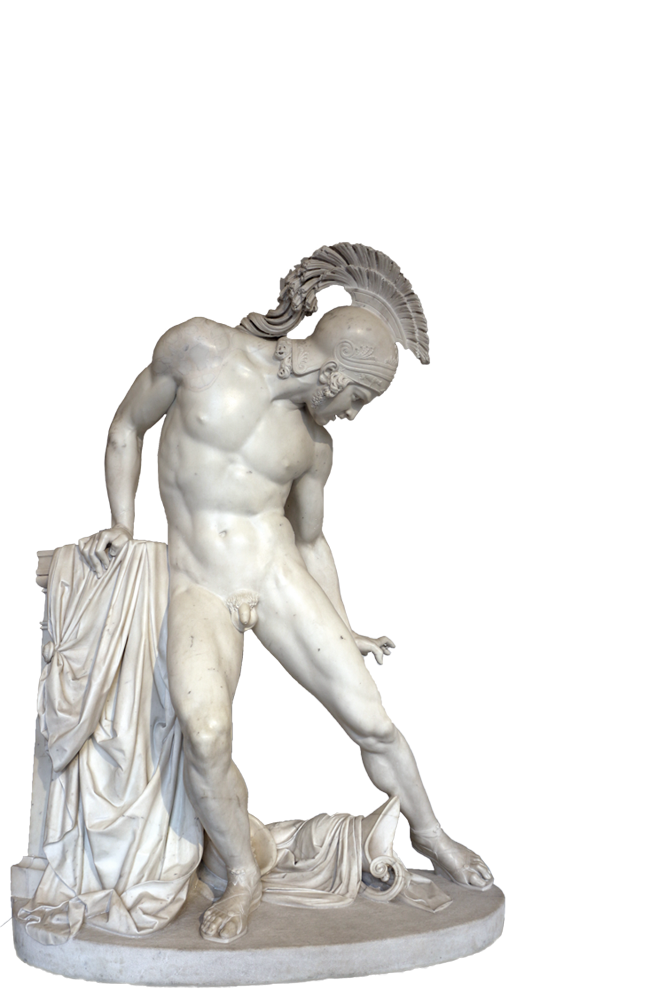
Wounded Achilles is considered Innocenzo Fraccaroli's masterpiece. The plaster model was already completed in 1832 during his stay in Rome (1830-1835), without any commission, but simply as a demonstration of his skill and mastery in the interpretation of the heroic male nude, on a par with masters such as Antonio Canova (1757-1822) and Bertel Thorvaldsen (1770-1844).
In 1842, ten years later, the Wounded Achilles was translated into marble thanks to funding from the sculptor's maternal uncle and presented at the Brera Exhibition, generating admiration and praise. The monumental sculpture is dedicated to the hero of Greek mythology and protagonist of the Iliad, who died at the hands of Paris after being struck in his only weak spot: his heel. The work captures a moment of extreme vulnerability in Achilles: the Greek hero, believed to be invincible, is captured in the moment of his mortal wound, when he understands his own weakness and fragility. Fraccaroli places the painful acceptance of his own end above heroism. Note the perfect balance of the counterweights: the right leg and arm are bent, the left leg is extended, with the face, torso, and arm tilted to the same side. This work by Fraccaroli also adheres to the canons of ideal beauty already sought by Canova, the greatest exponent of Neoclassicism in sculpture.